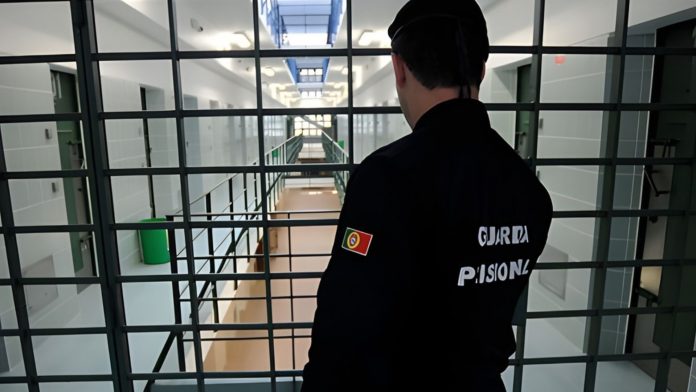
Portugal’s national union for prison staff has threatened to strike after a violent transgender inmate housed in a women’s facility injured five correctional officers. The inmate, born Miguel António and now known as “Raquel Teresa,” has since been transferred back to a men’s institution following what officials described as a prolonged campaign of intimidation against female staff and inmates.
According to Sábado, the 48-year-old has been in and out of the prison system since 1993 for a variety of primarily violent offenses. While it is unclear when António began identifying as transgender, Portugal’s Directorate-General for Reintegration and Prison Services (DGRPS) has stated that he has not undergone any medical transition procedures and has only legally changed his name.
Although António’s extensive criminal record is not comprehensively documented, it is known to span both Portugal and France. He was previously convicted in France of several serious crimes, including kidnapping, and served 15 years in prison. Portugal’s national union for prison guards (Sindicato Nacional do Corpo da Guarda Prisional) also reported that António was housed in two women’s prisons in Portugal as early as 2011 after receiving a sentence for rape.
This placement would have occurred before the passage of Law 38 in 2018, which allowed adults in Portugal to change their legal gender through self-declaration. Shockingly, it also predated Circulation 2, a prison guideline requiring that a transgender person’s gender identity be considered when determining institutional placement and case management.
By 2022, António was once again incarcerated for robbery. Initially placed in the Aveiro men’s facility, he was later transferred to the Santa Cruz do Bispo women’s prison, where he soon began attacking staff and fellow inmates. His behavior escalated to the point that domestic media outlets could no longer ignore the severity of the violence.
According to Jornal de Notícias, in September 2025 António attempted to drown a female inmate in a toilet. The following month, he reportedly assaulted another female inmate and two female prison guards.
Despite the clear danger he posed, António was subsequently moved to Tires – another women-only facility. Alarmingly, he was placed in Casa das Mães, a unit designated for mothers and their babies.
While being held in isolation in this unit, António set his mattress on fire, sparking a blaze that resulted in five prison guards being hospitalized.
He was briefly transferred to the Caxias hospital-prison, but the institution refused to keep him and returned him to Tires. At that point, the national union for prison guards (SNCGP) began publicly protesting the ongoing risk he presented to both staff and inmates. The case gained widespread attention in Portugal, and Justice Minister Rita Alarcão Júdice was grilled in parliament about the continued escalation.
Authorities finally buckled under pressure after SNCGP representatives demanded António’s transfer to the Monsanto men’s prison and threatened to call a workers’ strike if he was not removed from the women’s estate. Their strategy succeeded, and the Directorate-General for Reintegration and Prison Services agreed to transfer António to a maximum-security men’s facility.
Union president Frederico Morais celebrated the decision, noting that António “was putting the security of the [prison] establishment at risk.” In an interview with Renascença, Morais said that the union had placed a lot of pressure on the Government and the Directorate-General to transfer António to the Monsanto jail. After the transfer was announced, Morais said it came as a “huge relief” to staff, who had feared for their safety and the safety of the inmates.
According to Jornal de Notícias, António is currently being held in an isolated cell within Monsanto’s infirmary wing.
Reduxx is your source of pro-woman, pro-child safeguarding news and commentary. We’re 100% independent! Support our mission by making a one-time donation.
