
A trans-identified male serving a life sentence for the murder of his estranged wife’s partner has failed in his legal attempt to have cosmetic transsexual surgeries on the taxpayer dime. Nicholas Clark, who changed his name to Veronica-May Clark in 2021, was sentenced to 75 years in prison for bludgeoning his former wife and her partner savagely with a metal pipe, resulting in the man’s death.
During the early hours of November 17, 2007, Clark broke into the Newton, Connecticut home of his wife Christa Clark, where she lay asleep in bed with her partner, Erich Tabert. Nicholas and Christa had been separated since filing for divorce in February that year, and Christa had obtained a protective order against him due to incidents of domestic violence.
At approximately 4:30AM, Nicholas Clark gained entrance to the home by way of the window, carrying with him a metal rod to which he had affixed several screws in order to tear flesh. Christa Clark told police she awoke to her estranged husband beating Erich Tabert with the rod, crushing his skull under repeated and furious blows, before he turned the weapon on her.

Believing both victims to be dead, Nicholas Clark left the premises and dropped the weapon next to Tabert’s blood-covered body. Despite being severely injured, Christa Clark managed to contact emergency services. She was found to have sustained three fractures to her arm, a dislocated elbow, broken facial bones, and a severed nostril. She underwent seven reconstructive surgeries and was left permanently disfigured. Tabert was declared brain dead the same day, and his life support was terminated two days later.
Nicholas Clark was convicted in 2009 of murder, assault, burglary with a deadly weapon, and violation of a protective order. For the murder of Tabert, he was sentenced to 60 years, and for the brutal beating of his former wife, he was handed an additional 15 years.
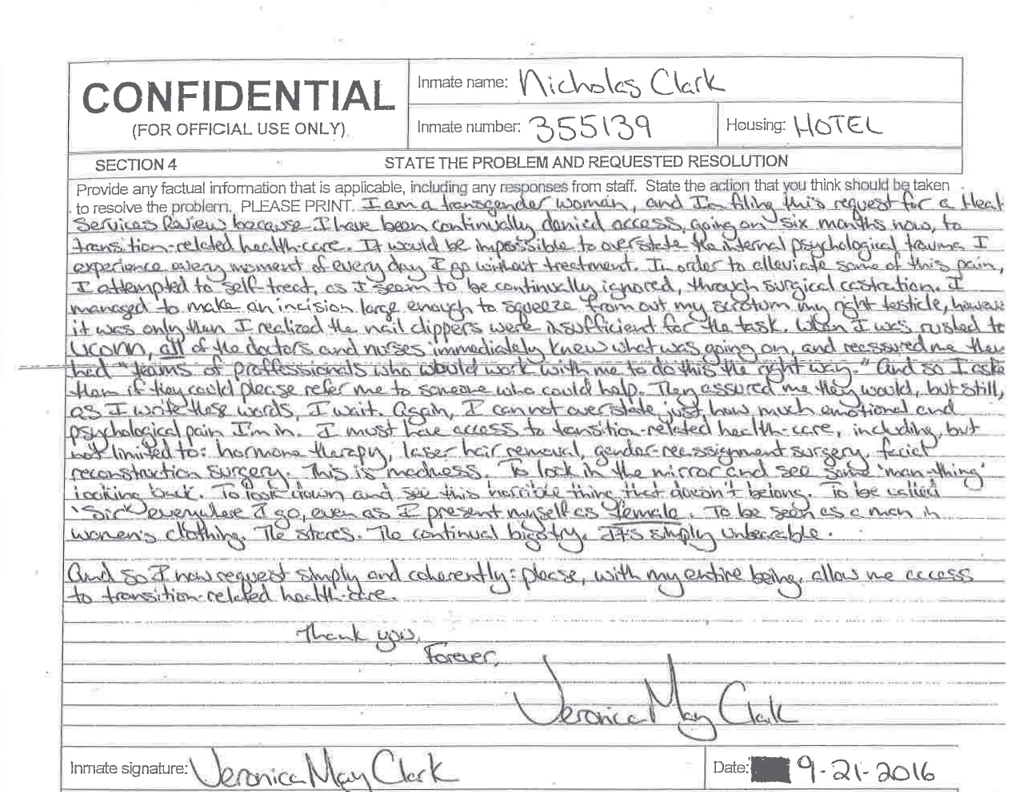
In April 2016, seven years into his prison term and being held at Cheshire Correctional Institution, Clark began claiming to identify as a woman. One month later, a health care provider assigned him a diagnosis of gender dysphoria, and in July of that same year, Clark attempted to castrate himself with a pair of nail clippers.
It was also at this time when Clark began lodging repeated requests for taxpayer-funded surgeries. According to court records, Clark was seeking several cosmetic procedures, including a hairline reconstruction, facial feminization surgery, breast implants, and a penile inversion.
However, during the past decade Clark had been shuffled around various male prisons in the state of Connecticut due to ongoing claims of persecution. From 2007 to 2011, Clark was held at MacDougall-Walker, where he ran a narcotics smuggling ring with correctional Officer Thomas Hanley. The DOC, learning of the contraband, launched an investigation into Hanley, and Clark accused the officer of sexually assaulting him. In September 2011, Clark was transferred to Corrigan Correctional Center.
Shortly after being transferred to Corrigan, Clark began a hunger strike demanding another transfer while claiming that his cellmate was abusing him. The DOC transferred Clark back to MacDougall-Walker in early 2012. He threatened suicide and again obtained a transfer, this time to Garner Correctional Facility, an inpatient psychiatric center. Two weeks later, he was moved to Cheshire Correctional Institution.
While at Cheshire, Clark complained that inmates were mocking him for his sexual relationship with Officer Hanley, which he said they referred to as “gay stuff.” In 2016, he was transferred back to Garner, where he remained until 2018.
While at Garner, Clark said he felt “safer,” and it was during this period that Clark began declaring a transgender status. The convicted killer also “expressed [his] great hope” to a director of an inpatient art program that “[he’ll] make it to the women’s prison.”
According to court records, Garner, a male institution, was stocked with “female commissary items like bras to purchase,” and in November 2017, an endocrinologist at the University of Connecticut (UConn) began providing Clark with hormones.
Clark had initially sought hormones in 2016, just after being transferred to Garner, but prison physician Dr. Gerald Valletta told Clark that he could not prescribe feminizing hormones due to a policy against supplying hormones to inmates unless they had a prescription prior to incarceration.
The killer then threatened litigation, and ten months later he was sent to the UConn physician. A follow-up appointment was not scheduled for another 22 months. In July 2018, Clark reported feeling “traumatized” by his erections and advancing male pattern baldness.
In April 2019, Clark filed a lawsuit against the Connecticut Department of Corrections (DOC) seeking a payout of $500,000 in damages, claiming that prison officials were violating his civil rights by denying him breast implants, electrolysis hair removal, and a higher dosage of feminizing hormones.
While initially representing himself in the lawsuit, in 2021 Clark secured the assistance of a professional legal team with the American Civil Liberties Union (ACLU) of Connecticut. In the case of Clark v. Quiros, the convicted killer received, pro bono, the legal counsel of Dan Barrett and Elana Bildner of the ACLU Foundation of Connecticut and Daniel Noble, Matthew Danzer, and Kelsey Powderly of Finn Dixon & Herling LLP.
Across the United States, the ACLU has initiated or been involved in at least a dozen lawsuits on behalf of convicted criminals who claim to identify as “transgender.” Their stance that violent men have a right to access cosmetic surgeries and feminizing hormones stands in contrast to a 2022 ACLU filing which said that human beings are “not sexually dimorphic,” and that males have no biological differences from females. The ACLU made the claim in response to a lawsuit launched by the Women’s Liberation Front on behalf of four female inmates incarcerated in California, one of whom was sexually assaulted by a trans-identified male transfer.
In July 2024, U. S. District Court Judge Victor Bolden ruled in favor of Clark, whose attorneys accused DOC officials of “intentional infliction of emotional distress” and that the failure to give Clark his desired hormones and surgeries constituted “extreme and outrageous” conduct.
However, on October 6, Judge Vanessa Lynne Bryant reversed the ruling in the Connecticut court of appeals, and argued that “inmates have no clearly established rights” to receive surgeries upon request.
Curiously, during a September 2021 hearing, court transcripts show that Clark made the bizarre claim that he had pleaded guilty to the cold-blooded killing and assault of his former wife in an attempt to prevent his attorney from outing him as a “transgender woman.” The statement was made during questioning over why he had waited seven years to file a lawsuit against the DOC and the officer he had claimed sexually abused him, Officer Hanley.
“I pled guilty to the charge of murder because I didn’t want to talk about the fact that I was trans,” Clark said. “It’s my understanding I had extreme emotional distress at the time. My attorney, for some reason, I don’t know why he didn’t use it as a defense because I understand that is a valid defense. And, you know, he scared me into pleading guilty because I’m trans,” Clark alleged.
“He’s like, ‘You know, if you go on the record, people will know about you in prison and you’ll have a hard time in prison with this.’ So I pled guilty not for any real reason… but to avoid talking about the fact that I’m a transgender woman,” he added.
Also mentioned during the 2021 court proceedings was a statement Clark had made when speaking with DOC mental health professionals in 2013. “I miss my kids, but I don’t regret what I did,” Clark told psychiatrists, referring to the murder of Tabert and the assault on Christa Clark. When questioned about the statement, Clark claimed that one of the psychologists had been “abrasive” to him.
Reduxx is your source of pro-woman, pro-child safeguarding news and commentary. We’re 100% independent! Support our mission by making a one-time donation.
