Home Blog Page 155

Senior Women Heckled During Rally For Single-Sex Locker Rooms at Community Pool

A peaceful demonstration held by women’s rights activists in support of an 80-year-old woman banned from her local pool was interrupted by aggressive trans activists who heckled the women as they spoke and attempted to destroy their equipment.

The demonstration took place yesterday evening in the small community of Port Townsend, Washington, a city with less than 10,000 residents that has become a hub for debate on women’s single-sex spaces after an 80-year-old model citizen was banned from the community’s pool after expressing concerns about a male in the women’s changing room.

Julie Jaman had been a guest at the YMCA-run Mountain View community pool for over 35 years. Speaking to Reduxx earlier this month, Jaman revealed that on July 26, she witnessed a trans-identified male using the female locker rooms at the pool, and became concerned due to the fact he appeared to be watching the young girls as they changed out of their bathing suits.

Jaman, who was herself nude as she was showering after a swim, demanded the male leave, but was quickly met with outrage from Rowen DeLuna, the pool’s aquatics manager who was in the locker room at the time. DeLuna berated her for being “discriminatory.”

“She said, ‘you are being discriminatory, you are banned from the pool, and I am calling the police.’ I was totally stunned,” Jaman says, adding that she felt particularly vulnerable, being yelled at while nude.

After Jaman came forward to press about her experience, the male in the women’s locker room was revealed as Clementine Adams — a transgender member of the pool’s staff who had only begun to transition weeks prior to self-identifying into the women’s locker room.

Clementine Adams

As news of Jaman’s ban from the pool began to spread, many took to social media to condemn the Mountain View Pool and the Olympic Peninsula YMCA and demand Julie have her membership reinstated.

On August 15, feminist activists associated with pro-safeguarding collective RevFoxxUSA organized a press conference near the Mountain View Pool in support of Jaman, inviting the senior citizen to speak about her experience. But the women were met with extreme hostility from trans activists, who had begun organizing a protest as soon as word of the press conference began to circulate on social media.

Gabrielle Clark, a free speech advocate and founding member of RevFoxxUSA, said the activists became so aggressive that she was genuinely frightened for Jaman’s safety, and the safety of the supporting women in attendance.

“We were attacked by [trans activists]. Fully grown men were getting in our faces, shoving, verbally abusing us, and attacking our equipment … Most of us were senior women. These were feminists who protested in the 1970s for women’s rights.” Clark, who travelled from out of state to assist with the conference, says.

Clark explains she had been introduced to Jaman by Amy Sousa, another founding member of RevFoxxUSA who lives near Jaman and has been a vocal advocate rallying support for her cause since her ban.
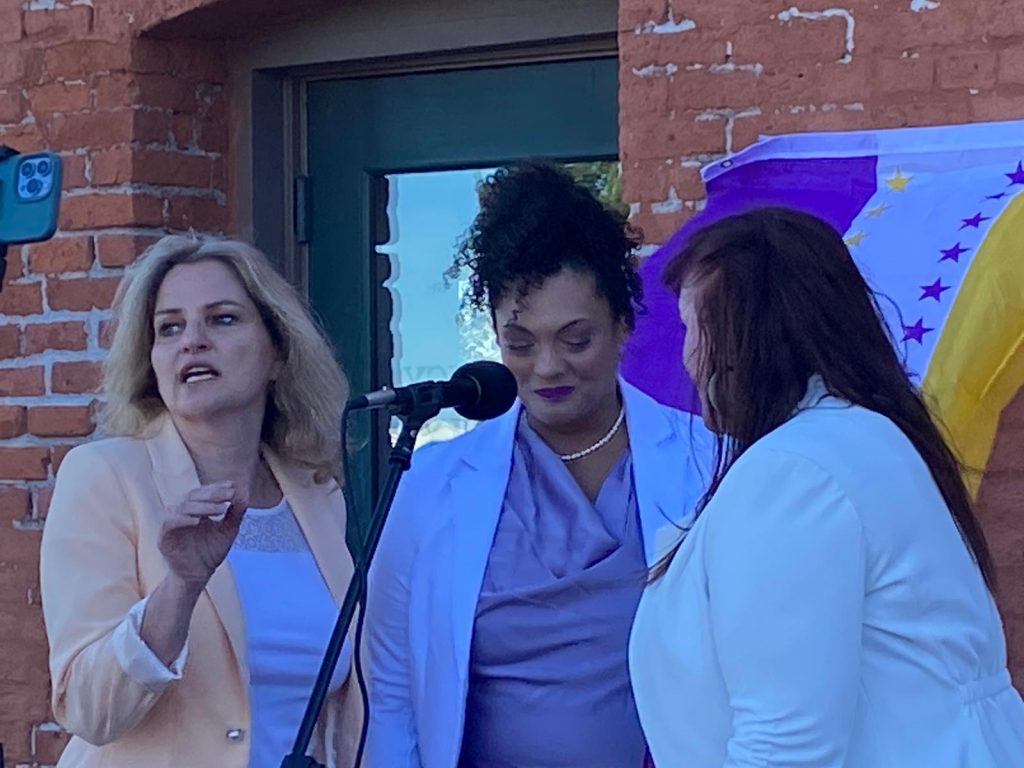
Gabrielle Clark [M], Amy Sousa [R], and Jennifer Thomas [L], three founding members of RevFoxxUSA, introducing the press conference. Photo Credit: Lynn Chadwick.

Clark was standing next to Jaman for almost the entirety of the conference, giving her words of encouragement as the increasingly vocal activists shouted her down and heckled her. At one point, an activist rushed behind Clark and ripped down the suffragette flags that had been pinned on the wall. But Clark didn’t let them go without a fight, immediately acting quickly to chase down the activist.

“I got a hold of the flags and yanked them back. I’m not letting anyone take anything from me again. Including my dignity.”

A woman in attendance at the event, asked only to be identified as Nora, said she witnessed one of the trans activists attempt to destroy the phone of a man who had been helping out with the press conference.

“I saw one counter protester grab [his] phone and run away with it … they threw it on the ground and tried to crush it with their foot before it was recovered,” Nora says, “I was approached by someone who verbally abused me despite standing quietly at the periphery, holding my signs and saying nothing.”

Nora also told Reduxx that many of the trans activists were physically aggressive with the women in attendance.

Port Townsend Police were present at the event, but many of the women who spoke to Reduxx affirmed they did very little to keep the peace.

Gabrielle Clark says Amy Sousa had contacted the police prior to the event to request support, and that other women associated with RevFoxxUSA listened to the call over speaker in which Police Chief Olsen told them law enforcement would be available.

“We called them ahead of time to make sure that they would be there to keep the peace. They assured us that they would. We told them that there would be mostly seniors,” Clark explains, “[But] police did nothing. They let the mob attack senior citizens. They could have kept the peace but they hid around the corner.”
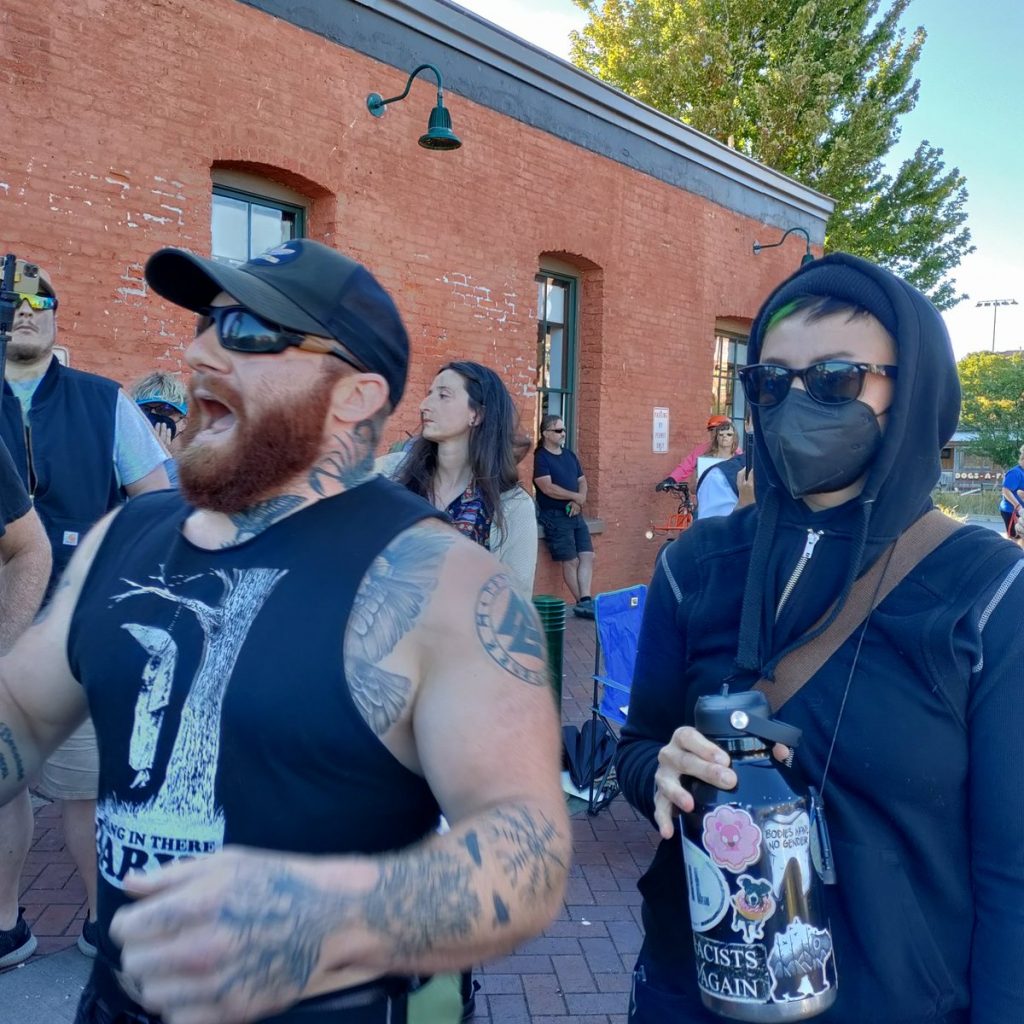
Photo: @technonymph/TWITTER.

During the live-broadcasted stream of the press conference, primarily male voices are heard screaming at the women and attempting to drown them out with chants.

Some pro-woman advocates in attendance have shared a photo on social media of a heavily-tattooed man they say was one of the most vocal hecklers. The bearded individual was wearing a t-shirt with a lynched klansman on the front.

Lynn Chadwick, a signatory of the Women Declaration and an advocate for parents of children with rapid onset gender dysphoria, says there were “at least 200” trans activists aggressively demonstrating against 30-40 women.

“I’ve been involved in feminist advocacy since early 2019. I lost my kids, all three, to the gender cult. The feminists were there to catch me. That’s when I began to see things through new eyes,” Chadwick says, “When Julie was born we had only had the vote for 20 years. I’m sure the women who fought so hard for our rights would never have envisioned this.”

Chadwick says the trans activists became so aggressive at one point that she was forced to call 911.

“They were shoving and pushing us hard. I turned around and told them, ‘you need to stop touching us. Right now. Stop touching us. It’s assault and I will file a report.’ They continued shoving us. They ripped down our flags and ran off with them. My friend had her sign stolen and ripped to pieces.”

After calling 911, Chadwick says she was told officers were already on the scene, but she says she didn’t see any police amongst the vicious section of the crowd to turn to for help, and that the officers were instead at the very periphery, standing in an area where nothing was at risk.

“There were a lot of older women who were very frightened,” Chadwick noted.

Despite the aggression, Gabrielle Clark says she was moved by the opportunity to stand alongside Julie Jaman and the other women in attendance, many of whom she says were fighting for women’s sex-based rights before she was born.

“Being a woman is a birthright. Nobody is going to take it away. It’s sad that a couple dozen octogenarians are being accused of bigotry when those very same people fought for all our rights half a century ago.”


Reduxx is a newly-launched independent source of pro-woman, pro-child safeguarding news and commentary. We’re 100% reader-funded! Support our mission by joining our Patreon, or consider making a one-time donation.

Texas Child Welfare Employee Fired After Encouraging Teen to Consider “Sex Work”

The Texas Department of Family and Protective Services has fired a support worker after a video emerged of her encouraging a vulnerable 14-year-old girl to consider becoming a prostitute to survive.

The shocking conversation was caught on film by the teen, who had begun recording her interactions with the worker after she had started to make similar suggestions on other occasions.

The video was released to Fox 26 News on Sunday, showing the girl covertly filming the worker explicitly telling her to become a prostitute. The interaction had taken place after the teen had approached the worker and asked for help to get food.

The teen was being housed the Harris County hotel awaiting foster care placement after entering the system at the request of her mother, who had become concerned about her daughter’s risky behavior.

“My daughter told me that the worker had been telling her to do these things, so she said she decided to video her,” Keisha Bazley, the girl’s mother, told Fox 26. Bazley filed a formal complaint and the video was shown to the Department, resulting in the staff member involved being terminated.

“The person in the video – who was employed as [Child Protective Services] support staff — was dismissed from her position August 10,” Marissa Gonzales, a Department spokesperson, said in a statement to the Texas Tribune. “The safety and appropriateness with which children in care must be treated is our paramount concern.”

Following the termination, Department Commissioner Jaime Masters travelled from Austin to Houston to personally apologize to the child and her mother.

But while Gonzales and the Department insisted that “nothing less” than the safeguarding of the youth in their care would be tolerated, this isn’t the first disturbing story out of the Texas child protection system in recent months.

In March, allegations surfaced that young girls in a government-contracted shelter for female youth victims of sex trafficking were being trafficked once again by their own case workers. Seven children, aged 11 to 17, were allegedly abused by 9 perpetrators working for the Refuge Ranch, which was run by the Refuge for Domestic Minor Sex Trafficking. An employee attempted to make the abuse known but the reports went neglected.

The employee had tried to alert the Department of Family and Protective Services, through which the private facility was operating, that a staff member had been selling nude photos of two of the young girls in their care, and had been buying illicit drugs and alcohol for the children. Despite the report, the Department failed to remove all of the children from the abusive care for five weeks after the first documented case of of exploitation had been brought to light.

While Texas Rangers reportedly found no evidence of any wrongdoing, court-appointed watchdogs discovered “ample” proof that the former child sex trafficking victims were being abused. According to court documents, allegations of child sex abuse, exploitation, neglectful supervision and physical abuse have all found substantiating evidence. The case is still under investigation.

In June, U.S. District Judge Janis Jack expressed her concerns that Texas’ child protection system was not performing adequate background checks on potential caregivers, according to the San Antonio Express-News.

Research has consistently found that children involved in the foster care or child protective service system experienced disproportionately higher rates of sexual and physical abuse.

A 2001 study by Johns Hopkins University found that children in foster care are four times more likely to be sexually abused than their non-foster peers, and children in group homes are 28 times more likely to be abused. Even more dramatic findings were published by child safeguarding organization Darkness To Light, which found that children living in foster care were 10 times more likely to be sexually abused than children residing with both biological parents.

According to the National Center for Missing and Exploited Children, 60% of runaway youth who are victims of sex trafficking had previously been in the custody of social services or in foster care.


Reduxx is a newly-launched independent source of pro-woman, pro-child safeguarding news and commentary. We’re 100% reader-funded! Support our mission by joining our Patreon, or consider making a one-time donation.
Empleada de Protección Infantil en Texas despedida por animar a una adolescente a prostituirse

El Departamento de Servicios Familiares y de Protección de Texas despidió a una trabajadora de apoyo cuando descubrió un video en el que animaba a una niña vulnerable de 14 años a considerar convertirse en prostituta para poder sobrevivir.

Fue la misma adolescente la que filmó la estremecedora conversación: ya había comenzado a grabar sus interacciones con la trabajadora al haber ésta empezado a hacerle sugerencias similares en otras ocasiones.

El video fue publicado por Fox 26 News el domingo, y muestra a la niña filmando en secreto a la trabajadora diciéndole explícitamente que se convirtiera en prostituta. La interacción había tenido lugar después de que la adolescente se acercara a la trabajadora y le pidiera ayuda para poder comer.

La adolescente estaba alojada en un hotel del condado de Harris a la espera de ser llevada a un hogar de acogida temporal, después de ingresar en el sistema a petición de su madre, quien se había empezado a preocupar por el comportamiento de riesgo de su hija.

“Mi hija me contó que la trabajadora le había estado diciendo que hiciera estas cosas, así que dijo que había decidido filmarla”, dijo Keisha Bazley, la madre de la niña, a Fox 26. Bazley presentó una queja formal y el video se mostró al Departamento, lo que resultó en que la empleada involucrada fuera despedida.

“La persona en el video, que estaba empleada como personal de apoyo [de los Servicios de Protección Infantil], fue despedida de su puesto el 10 de agosto”, dijo Marissa Gonzales, portavoza del Departamento, en un comunicado al Texas Tribune. “La seguridad y la propiedad con la que los niños bajo tutela deben ser tratados, es nuestra principal preocupación”.

Después del despido, el comisionado del Departamento Jaime Masters viajó de Austin a Houston para disculparse personalmente con la niña y su madre.

Pero aunque Gonzales y el Departamento insistieron en que no se iba a tolerar nada que pusiera en peligro la protección de los jóvenes bajo su cuidado, esta no es la primera historia inquietante del sistema de protección infantil de Texas en los últimos meses.

En marzo, surgieron denuncias de que las niñas de un refugio contratado por el gobierno para mujeres jóvenes víctimas de trata sexual estaban siendo traficadas una vez más, esta vez por sus mismos trabajadores sociales. Nueve de ellos, que trabajaban para el Rancho Refugio, administrado por el Refugio para el Tráfico Sexual Doméstico de Menores, abusaron presuntamente de siete menores, de entre 11 y 17 años. Un empleado intentó dar a conocer el abuso, pero sus informes fueron omitidos.

El empleado había tratado de alertar al Departamento de Servicios Familiares y de Protección, del que depende el centro privado, de que un miembro del personal había estado vendiendo fotos de desnudos de dos de las niñas a su cargo, y había estado comprando drogas y alcohol para los menores. A pesar del informe, el Departamento no retiró a todos los niños del hogar hasta cinco semanas después de que saliera a la luz el primer caso documentado de explotación.

Aunque los Texas Rangers no encontraron evidencia de ningún delito, los organismos de control designados por la corte descubrieron pruebas “abundantes” de que las ex víctimas de tráfico sexual infantil estaban sufriendo abusos. Según documentos judiciales, las denuncias de abuso sexual infantil, explotación, supervisión negligente y abuso físico cuentan con pruebas que lo corroboran. El caso aún está bajo investigación.

En junio, la jueza de distrito Janis Jack, expresó su preocupación de que el sistema de protección infantil de Texas no estuviera realizando investigaciones de antecedentes adecuadas de los cuidadores potenciales, según el San Antonio Express-News.

La investigación ha descubierto que los niños en hogares de acogida temporales o en el sistema de servicios de protección infantil experimentaron tasas desproporcionadamente más altas de abuso sexual y físico de una forma consistente.

Un estudio realizado en 2001 por la Universidad Johns Hopkins descubrió que los niños en hogares de acogida temporal tienen cuatro veces más probabilidades de sufrir abusos sexuales que sus compañeros que no están en hogares, y los niños en casas de acogida para grupos tienen 28 veces más probabilidades de sufrir abusos. La organización de protección infantil Darkness To Light ha publicado resultados aún más dramáticos: descubrió que los niños que viven en hogares de acogida temporal tenían 10 veces más probabilidades de sufrir abusos sexuales que los niños que residen con ambos padres biológicos.

Según el Centro Nacional para Niños Desaparecidos y Explotados, el 60% de los jóvenes fugitivos que son víctimas de tráfico sexual habían estado previamente bajo la custodia de los servicios sociales o en hogares de acogida.


Reduxx es una nueva plataforma en pro de los derechos de la mujer y de los menores de edad con noticias y artículos. Somos 100% independientes! Colabora con nuestro proyecto uniéndote a nuestro Patreon

“Lesbian Sex” Guide Advises That Lesbians May Have a Penis

Healthline is under fire for publishing an article in which it advises lesbian woman on “penis-in-vagina” sex, and warns about the risks of getting pregnant.

On August 1, medical information and lifestyle site Healthline updated a guidance article titled “How Do Lesbians Have Sex? 28 Things to Know Before Your First Time.” Like all Healthline publications, the article claims it was “medically reviewed” by a qualified doctor prior to posting, and in this case the professional listed is Dr. Janet Brito, whose bio states she is a “nationally certified Latinx sex therapist, supervisor, speaker, trainer, and author.”

The article starts out by informing readers that lesbian sex may not necessarily refer to sex between two women, and that one or both of the partners involved in the lesbian relationship may not even be female.

“‘Lesbian sex’ isn’t limited to cisgender couples. It also includes other people who have vaginas, people with penises, and people with intersex genitalia,” the article states, continuing: “So, whatever counts as ‘lesbian sex’ is really up to whoever is doing it.” The guidance also suggests both partners involved in the “lesbian sex” may have a penis, and also advises on the best positions for anal sex.

Throughout the article, Healthline asserts that a penis may be involved in lesbian sex, reminding readers that “just because you’re both women doesn’t mean you have the same genitals — for example, one person might be a cis woman with a vagina, while the other might be a trans woman with a penis.”

In a section of the guide on stimulation, Healthline provides guidance for lesbians on how to “manually stimulate someone who has a penis,” offering advice on “hand jobs” and orally stimulating the penis, scrotum, and perineum. The article also gives advice on penis-in-vagina and penis-in-anus sex.

Healthline also warns against pregnancy, advising birth control be used.

“It’s possible to get pregnant if one partner has a penis and another has a vagina,” it says, continuing: “often people assume that lesbians can’t get pregnant, or that lesbian sex can’t result in pregnancy. That’s a myth based on the assumption that both women are cisgender … If one partner is transgender and has a penis and the other is cisgender and has a vagina, they can have penis-in-vagina sex.”

The August 1 Healthline guide appears to be a re-publication of an earlier article released on July 22, though it is unclear what was changed in the update apart from the professional who conducted the “medical review.” Previously, the article had been “medically reviewed” by Jennifer Litner, who, similar to Brito, is not a medical doctor but a sex therapist.

After the guidance first began circulating on social media at the end of July, many users expressed outrage at the suggestion that lesbian sex could involve penises and risks of pregnancy, with some calling it “conversion therapy.”

Others noted that any sex that involved non-females was, by definition, not lesbian sex.

This isn’t the first time Healthline has experienced backlash for an overly “woke” article. The site has multiple resource guides referring to women as “vulva owners,” “menstruators,” and “pregnant people.” In an article published last year, lesbianism was defined as a “non-man” who is romantically or sexually interested in “non-men.”

Speaking to Reduxx on the Healthline guidance, Canadian lesbian activist Eva Kurilova rejected the suggestions as being “outright harmful” to same-sex attracted women.

“No, HealthLine, lesbian sex does not involve a penis and does not come with the possibility of pregnancy.”

Kurilova is a journalist with Gender Dissent, an outlet and organization which describes itself as focused on “examining and exposing the powerful corporate and political connections” behind gender ideology.

“[Resources for lesbians] are already hard to find without stumbling upon pornographic content. This ‘lesbian sex’ guide contributes to the problem by erasing the reality of female homosexuality and using it for further male validation,” Kurilova said.

“It also steps right into conversion therapy territory by framing ‘lesbian sex’ as sex that might just happen to include a penis. This kind of messaging makes it harder for lesbians to maintain sexual boundaries and refuse the advances of males who ‘identify’ as lesbians.”

Activist campaigns and rhetoric targeted at demanding lesbians be sexually receptive to including trans-identified males in their dating pool have seen sharp increases in recent years, with trans activists labelling exclusive female homosexuality as “the cotton ceiling.” The term was inspired by the concept of the “glass ceiling,” which is used to describe discrimination women face in the workplace that prevents them for reaching upper management levels. The “cotton” refers to the material of a women’s underwear, and frames a lesbian’s refusal to have sexual relations with males as a form of discrimination. 

In July, during the employment tribunal hearing of lesbian barrister Allison Bailey, a lawyer argued that a “cotton ceiling” workshop intended to deconstruct lesbian sexual barriers was “similar to South Africa attempting to racially integrate society.”

Over the past two months, lesbians in multiple countries have reported experiencing assault, intimidation, or abuse at pride marches or women’s activist events.

On August 7, a lesbian activist in Germany filed a police report after being assaulted by trans activists at the Dyke March Hamburg for holding a sign which defined lesbian as a “female homosexual.”


Reduxx is a newly-launched independent source of pro-woman, pro-child safeguarding news and commentary. We’re 100% reader-funded! Support our mission by joining our Patreon, or consider making a one-time donation.

OPINION: Transitioning Dead Women

According to historian Bettany Hughes, of all written and recorded history, only 0.5% is about women despite women consistently making up about 50% of the population.

But though the odds were stacked against them, many incredible women and girls defied the often-oppressive confines of their gender roles to become recognizable household names. This is a positive. After all, little girls having a diverse range of same-sex figures to look up to and be inspired by should be, by all accounts, a good thing. And, surely, no one would stand in opposition to recognizing the great women of history who have such little space to shine as it is, right?

Ha! Wrong!

In recent years, gender ideologues have taken their great eraser to the textbooks of history in an attempt to redefine and otherwise revise the record to insert themselves where they were never before mentioned. As in all other issues, the ideologues are particularly heavy-handed when it comes to women.

History’s great females have not been spared the influence of gender ideology, which, itself is historically non-existent. After all, modern gender theory is a new concept. The concept of gender as we understand it was coined in the 1960s by disgraced sexologist John Money. The term “transgender” was also coined in the 1960s but only gained popularity in recent years. Similarly, “non-binary” has existed only since the 1990s.

Applying terms related to “gender identity” to individuals who existed long before the terms did is moot, and more of a type of bizarre fan fiction than anything else.

But that hasn’t stopped the trans-historians of trans-history. Armed with sexist stereotypes, they have been marching through history’s great women, so kindly “correcting” the record of their lives where they have determined one or another wasn’t sufficiently “womanly” enough. All in the name of smashing the gender binary, of course.

The most recent example of this is the Sainted Joan of Arc. Joan was a French heroine that led the French army to victory against the English in 1429, purportedly after receiving divine guidance to do so. As she led troops into battle, she donned more practical men’s clothes and armor. After being captured by the English in 1430, she was tried in a kangaroo court on charges of witchcraft, heresy, and defying the divine law for having dressed as a man. She was burned alive in 1431 at the age of 19.

An incredible story of an inspiring, powerful woman.

… Until now.

On August 11, London-based theatre Shakespeare’s Globe announced it’s upcoming play I, Joan, which would re-write her story to make her non-binary who utilized ‘they/them’ pronouns.

In their description of the play it reads, “Rebelling against the world’s expectations, questioning the gender binary, Joan finds their power and their belief spreads like fire.”

While it is true that Joan defied the world’s expectations of her, play writer Charlie Josephine’s implication that she was less of a woman for doing so only reinforces these societal expectations of what a woman should be.

Calling Joan “they” instead of “she” does nothing to question the gender binary. Rather than acknowledging that Joan was a woman who overcame the expectations imposed upon her because of her sex, Joesphine suggests that being a woman is nothing more than adherence to those very expectations.

Rejecting gender roles such as femininity and submissiveness is to reject womanhood itself. The gender binary is not being questioned, it is being upheld in the most extreme way possible. Part of the reasons cited by the English for Joan’s execution was her gender non-conformity. Nearly 600 years later, and the message is still the same; women don’t act this way, women don’t dress this way, women aren’t warriors, women aren’t leaders. 

Unsurprisingly, this is not the first time Joan has been posthumously transitioned.

The controversial private gender clinic, GenderGP published an article on their website in 2021 titled “Non-binary people in history: Why aren’t they recognized?” and included Joan of Arc in their breakdown.

“The famous French warrior Joan of Arc used female pronouns, but when she was called by God, took up exclusively masculine clothing and social roles,” it read.

Groundbreaking.

Unfortunately, Joan is not the only woman who has had her womanhood stripped from her for not conforming to their stereotypical sex-role.

A blog post referred to the founder of modern nursing, Florence Nightingale, by he/him pronouns because she sometimes called herself a “man of action” and a “man of science,” and had a close, documented relationship with a female friend. They argued that it was far more likely that she was a man than a lesbian.

The author of Little Women, Louisa May Alcott, has also been described as “trans” by both activists and Queer news outlet LGBTQ Nation. A tweet from earlier this year wracked up over 34,000 likes after a round-bespectacled gender special firmly declared Alcott was transgender.

It is true… Alcott often expressed wishing she had been born a boy. But was is the likelihood she simply envied the freedom that was afforded to boys and men during the time period in which she lived?

Struggling to conform to gender stereotypes and female socialization is a major theme of Alcott’s most famous novel. The novel tells the coming of age stories of four sisters, two of the sisters, Amy and Jo initially attempt to break free from the constraints of gender roles. The novel questions the validity of gender stereotypes for both men and women. But the commentary of Alcott’s novel, though published in 1868, are apparently too progressive for modern day trans activists who see Alcott’s and her characters rejection of gender roles as a sign they were really men.

Another example of a woman “transed” posthumously is diarist and landlord, Anne Lister, has been the topic of heated debates over the last several years due to a plaque honoring her originally excluding the word lesbian.

Lister did not identify as a lesbian, because the term was not in use at the time, but in her diaries she said she only loved the “fairer sex” and described her relationships with women. Lister also took communion with another woman in what has been described as the first lesbian wedding in the UK. But activists have argued that due to the fact Lister dressed in masculine clothing and adopted the nickname “gentleman Jack, ” she was really transgender.

Unsurprisingly, historical lesbians are among the most likely to be posthumously transitioned, which does nothing but demonstrate that lesbophobia runs deep within gender ideology. Subscribers to this world view even go as far as to say having affairs and relationships with women is a sign that a woman is not truly female.

There is no where this is more demonstrated than in the historical revisionism surrounding “female husbands.” This was a rare phenomenon through the 17th – 19th centuries in which women attempted to live as men, and sometimes even married women in the process.

One of the most noted “female husbands” was Sarah Paul, who went by the name Samuel Bundy. Paul was sent to prison after being convicted of defrauding a woman named Mary Parlour by marrying her as a man, but Parlour is largely believed to have been pressured by her community into pressing charges against Paul as she had known Paul was a woman throughout their relationship.

Other “female husbands” had similar stories, though in some cases, their female partner was truly ignorant to their true sex and was quite surprised to discover they hadn’t married a man, such as in the case of Mary Hamilton.

In 2020, Jen Manion released a book asserting that effectively every “female husband” was either transgender or non-binary, totally skipping over the possibility they simply could have been lesbian women or women who just wanted the same freedoms as men had. This claim has been repeated in the Guardian as recently as last year. Interestingly, it appears that most sources pre-2019 viewed the “female husbands” largely as lesbian women seeking to live in peace with their partners.

The proponents of transitioning these dead women love to claim their intentions are rooted in smashing the gender binary and defying gender norms, but, without fail, the subtext is always identical to the narrative of most extremist of misogynistic traditionalists. So rapidly do the gender binary smashers become the gender binary gestapo.

Women cannot be women unless they act, dress, love, and conform in very specific ways.

A fantastic example of that is the female Viking warrior who was recently posthumously transed because of the way in which she was buried.

In the 1870s, when her 10th century grave was first uncovered, the Viking warrior was originally assumed to be male because of how she was buried. But in 2017, with the advancement of forensic science, she was determined to have been female. Rather than being both curious and excited for the prospect to learn of a great female soldier, the revelation left academics scrambling to argue that she may have been “transgender, non-binary or gender fluid.”

Despite this being promoted as the “progressive” viewpoint, it almost twins the line of thinking of the original researchers who undercover the bones in the 1870s. Both saw a skeleton buried with honor and with weapons and thought: “This can’t be a woman, women can’t be warriors.”

Throughout history, remarkable women have rejected gender roles and shown the generations of women that came after them that there were many ways to be a woman. They showed us that woman can be scientists, warriors, writers and much more. They carved out a path for women who wanted to have short hair, or wear masculine clothing, or love other women, or even live independent of men. Now, gender ideologues are trying to regress society back to the rigid view of what women and men should be. If a woman does not adhere to these ideas, she must not really be a woman.

In this moment, I am reminded of the opening of Joan of Arc’s trial, historical records showing her persecutors referred to her gender bending behavior.

They called her disgraceful for “putting on the clothing of the male sex,” labelling it a “Striking and vile monstrosity” which disregarded “what is honorable in the female sex.”

If only they’d known she was non-binary!


Reduxx is a newly-launched independent source of pro-woman, pro-child safeguarding news and commentary. We’re 100% reader-funded! Support our mission by joining our Patreon, or consider making a one-time donation.
OPINIÓN: Transicionando mujeres muertas

Según la historiadora Bettany Hughes, de toda la historia escrita y registrada, solo el 0,5% trata sobre mujeres. a pesar de que las mujeres constituyen consistentemente alrededor del 50% de la población.

Pero aún con todas las probabilidades en su contra, muchas mujeres y niñas increíbles desafiaron los confines a menudo opresivos de sus roles de género para convertirse en nombres fácilmente reconocibles. Eso es positivo. Después de todo, que las niñas tengan una amplia gama de personajes del mismo sexo a las que admirar y en quien inspirarse deberían ser, obviamente, algo bueno. Y, por supuesto, nadie se opondría a reconocer a las grandes mujeres de la historia que ya tienen tan poco espacio para brillar de por sí, ¿verdad?

¡Ja! ¡Falso!

En los últimos años, los ideólogos de género han pasado sus enormes gomas de borrar por los libros de texto de historia en un intento de redefinir y corregir documentos para meterse donde nunca antes habían sido mencionados. Como en todos los demás temas, los ideólogos son particularmente duros cuando se trata de mujeres.

Las grandes mujeres de la historia no se han librado de la influencia de la ideología de género que es, en sí misma, históricamente inexistente. Después de todo, la teoría de género moderna es un concepto nuevo. El concepto de género tal como lo entendemos fue acuñado en la década de los 60 por el sexólogo caído en desgracia John Money (aquí en español). El término “transgénero” también se acuñó en la década de los 60, pero no ganó popularidad hasta hace unos años. Del mismo modo, “no binario” no existía  hasta la década de los 90.

Aplicar términos relacionados con la “identidad de género” a individuos que existieron mucho antes que esos términos no tiene objeto, y es más un tipo de fan fiction extraño que otra cosa.

Pero eso no ha detenido a los trans-historiadores de la trans-historia. Armados con estereotipos sexistas, han pasado revista a las grandes mujeres de la historia, y han “corregido” amablemente el testimonio de las vidas de aquellas que, en su opinión, no eran lo suficientemente “femeninas”. Todo en nombre de romper el binarismo de género, por supuesto.

El ejemplo más reciente es Juana de Arco. Juana fue una heroína francesa que llevó al ejército francés a la victoria contra los ingleses en 1429, supuestamente después de recibir inspiración divina. Cuando conducía a las tropas a la batalla, se ponía ropa y armadura de hombre por ser más prácticas. Después de ser capturada por los ingleses en 1430, fue juzgada en un tribunal popular por cargos de brujería, herejía y por desafiar la ley divina por haberse vestido de hombre. Fue quemada viva en 1431 a la edad de 19 años.

Una historia increíble de una mujer inspiradora y poderosa.

… Hasta ahora.

El 11 de agosto, el teatro londinense Shakespeare’s Globe anunció su próxima obra I, Joan (Yo, Juana), que iba a reescribir la historia para volver a Juana no binaria y hacer que utilizara los pronombres “elle/elles”.

En la descripción de la obra se lee: “Rebelándose contra las expectativas del mundo, cuestionando el binarismo de género, Joan encuentra su (de elle) fuerza y su (de elle) fe se extiende como el fuego”.

Si bien es cierto que Joan desafió las expectativas del mundo sobre ella, la implicación de la escritora Charlie Josephine (no binarie) de que era menos mujer por hacerlo, no hace más que reforzar estas expectativas sociales de lo que debería ser una mujer.

Llamar a Joan “elle” en lugar de “ella” no hace nada por cuestionar el binarismo de género. En lugar de reconocer que Joan fue una mujer que superó las expectativas que se le impusieron debido a su sexo, Josephine sugiere que ser mujer no es más que el cumplimiento de esas mismas expectativas.

Rechazar los roles de género como la feminidad y la sumisión es rechazar la condición misma de mujer. El binarismo de género no está siendo cuestionado, está siendo ratificado de la manera más extrema posible. Parte de las razones citadas por los ingleses para la ejecución de Joan fue su inconformidad de género. Casi 600 años después, y el mensaje sigue siendo el mismo; las mujeres no actúan de esta manera, las mujeres no se visten de esta manera, las mujeres no son guerreras, las mujeres no son líderes.

Como era de esperar, esta no es la primera vez que Joan ha sido sometida a una transición póstuma.

La polémica clínica privada de género, GenderGP publicó un artículo en su sitio web en 2021 titulado “Personas no binarias en la historia: ¿Por qué no son reconocidas?” e incluyó a Juana de Arco en su desglose.

“La famosa guerrera francesa Juana de Arco usaba pronombres femeninos, pero cuando fue llamada por Dios, asumió ropa y roles sociales exclusivamente masculinos”.

Revolucionario.

Desafortunadamente, Joan no es la única mujer a la que se le ha despojado de su condición de mujer por no ajustarse a su estereotipo de rol sexual.

Una publicación de blog usaba pronombres masculinos para referirse a la fundadora de la enfermería moderna, Florence Nightingale,  porque a veces se llamaba a sí misma un “hombre de acción” y un “hombre de ciencia”, y tenía una estrecha y bien documentada relación con una amiga. Argumentaban que era mucho más probable que fuera un hombre que una lesbiana.

La autora de Mujercitas, Louisa May Alcott, también ha sido descrita como “trans” tanto por activistas como por el medio de noticias queer LGBTQ Nation. Un tweet de principios de este año se llevó más de 34,000 me gusta cuando una persona de género especial con gafas redondas declarara firmemente que Alcott era transgénero.

Es cierto… Alcott a menudo expresaba su deseo de haber nacido un niño. Pero, ¿no era más probable que simplemente envidiara la libertad que se les daba a los niños y hombres durante el período en el que vivió?

Luchar por ajustarse a los estereotipos de género y la socialización femenina es un tema importante de la novela más famosa de Alcott. La novela cuenta las historias del paso de la pubertad de cuatro hermanas, dos de las cuales, Amy y Jo, inicialmente intentan liberarse de las limitaciones de los roles de género. La novela cuestiona la validez de los estereotipos de género tanto para hombres como para mujeres. Pero la novela de Alcott, aunque publicada en 1868, es aparentemente demasiado progresistas para los modernos activistas trans que ven el rechazo de Alcott y sus personajes a los roles de género como una señal de que realmente eran hombres.

Otro ejemplo de una mujer “transeada” póstumamente es la diarista y terrateniente, Anne Lister, que ha sido objeto de acalorados debates en los últimos años debido a una placa en su honor que originalmente excluía la palabra lesbiana.

Lister no se identificaba como lesbiana, porque el término no estaba en uso en aquel momento, pero en sus diarios decía que solo amaba el “bello sexo” y describía sus relaciones con las mujeres. Lister también recibió el sacramento con otra mujer en lo que se ha calificado como la primera boda lesbiana en el Reino Unido. Pero los activistas argumentan que, debido al hecho de que Lister se vestía con ropa masculina y había adoptado el apodo de “gentleman Jack”, era en realidad transgénero.

Como era de esperar, las lesbianas históricas se encuentran entre las más propensas a ser transicionadas póstumamente, lo que no hace más que demostrar que la lesbofobia está profundamente arraigada en la ideología de género. Los partidarios de esta visión del mundo llegan incluso a decir que tener aventuras y relaciones con mujeres es una señal de que una mujer no es realmente una mujer.

Y en ningún sitio está esto más demostrado que en el revisionismo histórico que rodea a las “mujeres maridos”. Este fue un fenómeno raro ocurrido entre los siglos XVII y XIX por el cual algunas mujeres intentaban vivir como hombres, y a veces incluso se casaron con otras mujeres en el proceso.

Una de las “mujeres maridos” más notables fue Sarah Paul, que se hacía llamar Samuel Bundy. Paul fue encarcelada después de ser declarada culpable de estafar a una mujer llamada Mary Parlour al casarse con ella como hombre, pero se cree que Parlour fue presionado por su comunidad para presentar cargos contra Paul, ya que sabía que Paul era una mujer a lo largo de su relación.

Otras “mujeres maridos” cuentan historias similares, aunque en algunos casos, su pareja femenina era realmente ignorante de su verdadero sexo y se sorprendió bastante al descubrir que no se habían casado con un hombre, como en el caso de Mary Hamilton.

En 2020, Jen Manion sacó un libro donde afirmaba que de hecho las “mujeres marido” eran transgénero o no binarias, omitiendo totalmente la posibilidad de que pudieran haber sido simplemente lesbianas o mujeres que solo querían las mismas libertades que tenían los hombres. Esta afirmación se ha repetido en The Guardian tan recientemente como el año pasado. Curiosamente, parece que la mayoría de las fuentes anteriores a 2019 veían a las “mujeres maridos” en gran medida como lesbianas que buscaban vivir en paz con sus parejas.

A los defensores de la transición de estas mujeres muertas les encanta afirmar que sus intenciones radican en romper el binarismo de género y desafiar las normas de género, pero, sin excepción, el subtexto siempre es idéntico a la narrativa de los más extremistas de los tradicionalistas misóginos. Así de rápido los destructores del binarismo de género se convierten en la gestapo del binarismo de género.

Las mujeres no pueden ser mujeres a menos que actúen, se vistan, se conforme y amen de maneras muy específicas.

Un ejemplo fantástico de eso es la guerrera vikinga que recientemente fue transeada póstumamente debido a la forma en que fue enterrada.

En la década de los 70 del siglo XIX, cuando su tumba del siglo XX fue descubierta, se asumió en un principio que la guerrera vikinga era un hombre debido a cómo fue enterrada. Pero en 2017, con el avance de la ciencia forense, se descubrió que era una mujer. En lugar de sentir curiosidad y entusiasmo por la perspectiva de conocer a una gran soldado, la revelación dejó a los académicos intentando argumentar que pudo haber sido “transgénero, no binaria o de género fluido“.

A pesar de que esto se promueve como el punto de vista “progresista”, es una línea de pensamiento casi idéntica a la de los investigadores originales que descubrieron los huesos en 1870. Ambos vieron un esqueleto enterrado con honor y con armas y pensaron: “Esto no puede ser una mujer, las mujeres no pueden ser guerreras”.

A lo largo de la historia, mujeres notables han rechazado los roles de género y han demostrado a las generaciones de mujeres que vinieron después de ellas que había muchas maneras de ser mujer. Nos mostraron que las mujeres pueden ser científicas, guerreras, escritoras y mucho más. Abrieron un camino para las mujeres que querían llevar el pelo corto, o usar ropa masculina, o amar a otras mujeres, o incluso vivir independientemente de los hombres. Ahora, los ideólogos de género están tratando de hacer retroceder a la sociedad a la visión rígida de lo que deberían ser las mujeres y los hombres. Si una mujer no se adhiere a estas ideas, no puede ser realmente una mujer.

Me recuerda al inicio del juicio de Juana de Arco: los registros históricos muestran que sus perseguidores se refirieron a su rebeldía hacia los estereotipos de género.

La llamaron escandalosa por “ponerse ropa del sexo masculino”, calificándola de “monstruosidad llamativa y vil” que ignoraba “lo que es honorable en el sexo femenino”.

¡Ah, si supieran que era no binaria!


Reduxx es una nueva plataforma en pro de los derechos de la mujer y de los menores de edad con noticias y artículos. Somos 100% independientes! Colabora con nuestro proyecto uniéndote a nuestro Patreon

Miss Transgender Peru Arrested on Human Trafficking Charges in Belgium

A two-time Miss Transgender Peru winner has been arrested in Belgium after reportedly trafficking people into the sex trade, making some of them veritable slaves in Europe’s most famous legal red light districts.

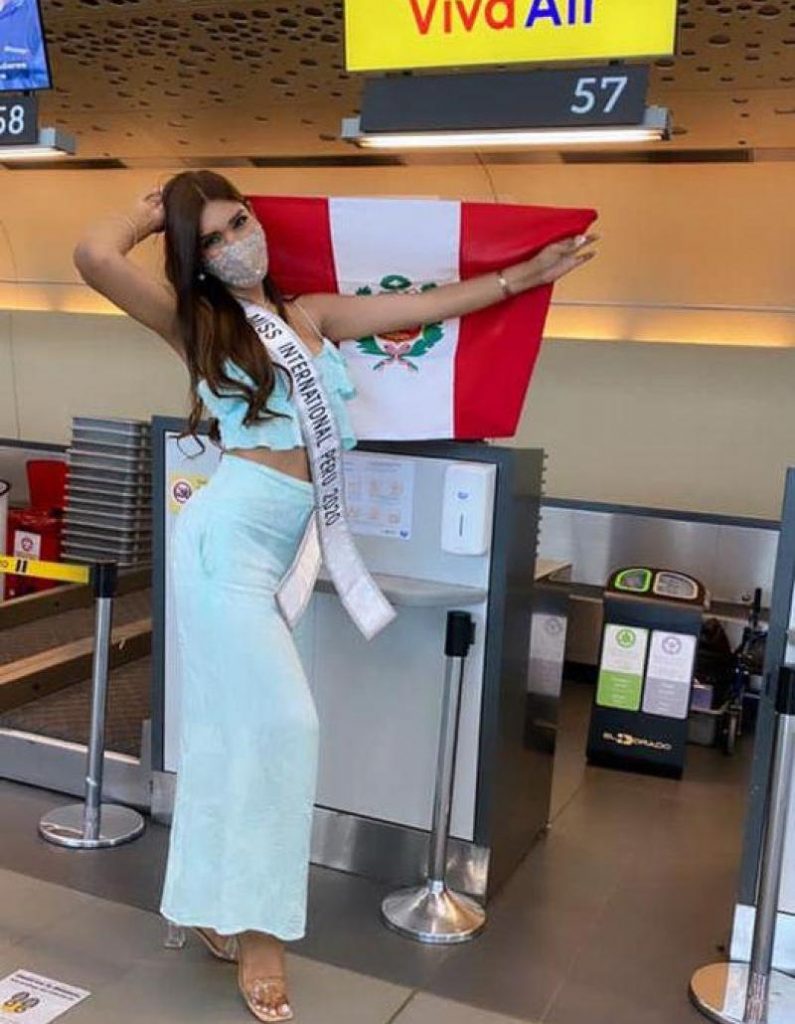
Celeste Rivasplata, 34, is a widely known social media influencer in Peru for having won two national Miss Transgender titles in 2019 and 2021, as well as Miss International Peru that same year. But Rivasplata, a biological male who identifies as a woman, is now facing human trafficking charges after police became aware he was running an international sexual exploitation ring with one dozen victims.

Rivasplata in Columbia, July 2021. Source: @celesterivasplataofical/INSTAGRAM

According to La Meuse, Rivasplata would solicit vulnerable trans-identified young people from Peru, offering them a better life in Belgium.

While the exact ages of the victims is unknown, Rivasplata’s father would collect fees from them in Peru prior to their departure to Belgium. Once they arrived, Rivasplata would strip them of their passports and tell them their debt could only be paid through prostitution. The victims were also threatened that their families back in Peru would be harmed if they did not comply.

Rivasplata rented apartments and hotel rooms in 6 cities in Belgium where prostitution had some legal protections, as well as in Utrecht, Netherlands, where he housed the victims, leaving them with nothing more than food. He then placed ads featuring the victims on the internet, including on red light district escorting websites, and handled the bookings. Clients were charged €150 to €300 for “passes” that then gave them access to their chosen victim.

The money Rivasplata collected was apparently laundered using an international wire transfer agency back to Peru, with some administrators being paid a bribe to not log Rivasplata’s identification with every transaction.

Rivasplata was arrested on July 7 after police became aware of the operation and connected him to the trafficking victims through digital means. He was jailed in a women’s holding cell in Berkendael prior to being released without conditions after a €7,000 bail was paid on Wednesday.

In local news reports on Rivasplata’s charges, he was referred to using feminine pronouns.

In 2019, Rivasplata was featured on multiple Peruvian television programs after the country introduced gender self-identification laws. In one interview, Rivasplata stated that previous Peruvian policies not allowing him to change his legal markers were unfair because he “felt like a woman” and wanted to be perceived and treated as one.


Reduxx is a newly-launched independent source of pro-woman, pro-child safeguarding news and commentary. We’re 100% reader-funded! Support our mission by joining our Patreon, or consider making a one-time donation.
Miss Trans Perú arrestado por trata de personas en Bélgica

El dos veces ganador de Miss Transgénero Perú ha sido arrestado en Bélgica por presunto tráfico de personas para el comercio sexual, y por haber convertido a algunas de ellas en verdaderas esclavas en los barrios rojos legales más famosos de Europa.

Celeste Rivasplata, de 34 años, es un influencer de redes sociales muy conocido en Perú por haber ganado dos títulos nacionales de Miss Transgénero en 2019 y 2021, así como Miss Internacional Perú ese mismo año. Pero Rivasplata, un hombre biológico que se identifica como mujer, se enfrenta ahora a cargos de trata de personas después de que la policía se enterara de que dirigía una red internacional de explotación sexual con una docena de víctimas.

Según La Meuse, Rivasplata captaba a jóvenes vulnerables identificados como trans de Perú, y les ofrecía una vida mejor en Bélgica.

Rivasplata en Columbia, julio de 2021. Fuente: @celesterivasplataofical/INSTAGRAM

Si bien se desconoce la edad exacta de las víctimas, el padre de Rivasplata les cobraba una tarifa en Perú antes de su partida a Bélgica. Una vez que llegaban, Rivasplata les quitaba los pasaportes y les decía que su deuda solo podía pagarse a través de la prostitución. A las víctimas también se les amenazaba con daños a sus familias en Perú si no accedían.

Rivasplata alquilaba apartamentos y habitaciones de hotel en 6 ciudades de Bélgica donde la prostitución tenía algunas protecciones legales, así como en Utrecht, Países Bajos, donde alojaba a las víctimas, dejándolas sin nada más que comida. Luego anunciaba a las víctimas en Internet, incluso en sitios web de escolta del barrio rojo, y manejaba las reservas. A los clientes se les cobraba entre 150 y 300 euros por “pases” que luego les daban acceso a la víctima elegida.

El dinero que Rivasplata recaudó aparentemente fue lavado utilizando una agencia de transferencias electrónicas internacionales en Perú, y algunos administradores recibían sobornos para no registrar la identidad de Rivasplata en cada transacción.

Rivasplata fue arrestado el 7 de julio cuando la policía se enteró de la operación y lo conectó con las víctimas de trata a través de medios digitales. Fue encarcelado en una celda de detención de mujeres en Berkendael antes de ser puesto en libertad sin condiciones después de pagar una fianza de 7.000 euros el miércoles.

Los informes de noticias locales sobre los cargos a Rivasplata hablaron de él usando pronombres femeninos.

En 2019, Rivasplata apareció en múltiples programas de televisión peruanos una vez que el país introdujo leyes de autoidentificación de género. En una entrevista, Rivasplata declaró que las políticas peruanas anteriores que no le permitían cambiar sus marcadores legales eran injustas porque “se sentía como una mujer” y quería ser percibido y tratado como tal.


Reduxx es una nueva plataforma en pro de los derechos de la mujer y de los menores de edad con noticias y artículos. Somos 100% independientes! Colabora con nuestro proyecto uniéndote a nuestro Patreon

PhD Student Who Wrote “Masturbation” Research Paper Also Published Graphic Teen Boy Magazines

The PhD researcher at the center of a firestorm surrounding a controversial research paper he published earlier this year was previously the creator of magazines which featured disturbing, graphic photos of young boys.

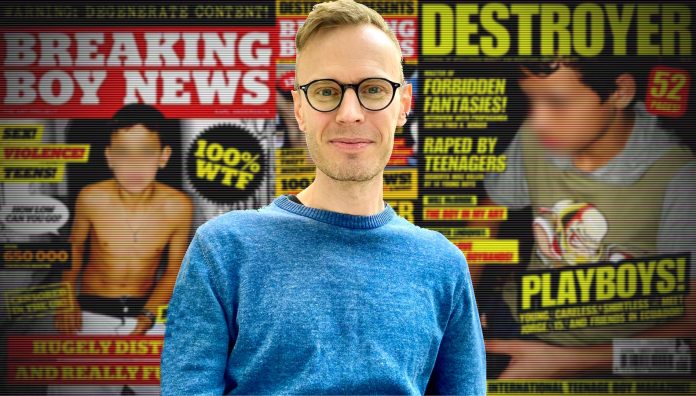
Karl Andersson. Photo Credit: University of Manchester.

Karl Andersson, a Swedish-born academic, is currently a PhD student at the University of Manchester in the Japanese studies department. According to his Researcher biography on the University’s site, his focus is on how “fans of subcultural comics in Japan experience desire and think about sexual identities.”

Andersson came under widespread scrutiny earlier this week after it was revealed he had written an academic article in which he admitted to masturbating to fantasy child sexual abuse material for three months as part of his “research.” The paper, titled “I am not alone — we are all alone: Using masturbation as an ethnographic method in research on shota subculture in Japan,” outlines Andersson undertaking an “experimental method” of masturbating to shota pornography.

Shota, a shortened version of shōtarō complex, refers to comics, cartoons, and other forms of visual media which focus on young boys in erotic and sexualized situations. The boys are primarily depicted as prepubescent, often having hairless bodies and very small features.

The medium is largely regarded as a form of fantasy child sexual abuse material, and is illegal in many countries including Canada and Australia as a result. It is also considered illegal in the United Kingdom, where Andersson may reside.

While Andersson does not reveal the ages of the youth in the sexual comics he masturbated to, he does refer to them as “young boys.” Later in the paper, Andersson writes that “very young boy characters would greedily jump over the first cock that presented itself” in a description of some of the comics he read.

The paper was published in April in Qualitative Research after peer-review. The journal has since come out and stated it was in the process of reviewing the entry.

But further investigation into Andersson’s background has revealed even more disturbing conduct.

From 2006 to 2010, Andersson was responsible for two disturbing visual media projects which focused on the sexualization of young boys.

Destroyer Magazine was Andersson’s first venture into the genre. Andersson was living in Prague and publishing out of the Czech Republic shortly after he graduated from Stockholm University, the graphic magazine billed itself as “the leading international teenage boy magazine!”

Two issues of Destroyer Magazine from 2007.

While Destroyer was derided in Sweden for its disturbing content, Andersson was sympathetically covered by Out, an international gay news outlet, in 2012.

“The most controversial expression of homosexuality is when a man is attracted to an adolescent boy,” Andersson is quoted as saying, “The [porn films] that are called ‘barely legal’ feature men dressed as boys … I find it quite uninteresting. It’s just drag. The models in Destroyer are well under 18.”

Andersson also stated that any criticism of the magazine was based in “homophobia,” and that: “the gay movement has lost touch with its past … It was founded to a large extent by men who were attracted to adolescent boys in Germany in the beginning of the 20th century. That should be acknowledged and it isn’t. We should honor them because we owe them our freedoms — instead, we despise them.”

In addition to Destroyer, Andersson also published another, even more graphic magazine titled Breaking Boy News, which focused on even younger teens and more gruesome content.

The stories focused on young boys committing violence against animals, girls, and each other, with a particular emphasis on pain and degeneracy.

In 2012, Vice interviewed Andersson on the now-defunct Breaking Boy News site.

Andersson states he created the side-project after searching for “news stories about stuff like ‘boy murders’ and ‘boy rapes’, added pictures and wrote smashing headlines.”

In the interview Andersson doesn’t shy away from the label “boy lover,” and appears to embrace his attraction.

“The boy is the one who does all the things we learn later in life not to do. He discovers things, tests limits, helps people, but he also robs, rapes or even murders. And they’re cute, of course. Boys are like kittens, it’s hard to take your eyes off them.”

Neither Destroyer Magazine nor Breaking Boy News featured fully nude portrayals of the youth, enabling them to skirt around legal restrictions. During the Vice interview, Andersson stated he had no concerns about legality, going on to scoff at child welfare advocates who had expressed concerns about his material.

“I was denounced by children’s advocates for allegedly ‘sexualizing children,’ but I said that teenage boys aren’t children, but are in fact sexual – something I enhanced in my magazine, which was a tribute to the teenage boy.”

Andersson also mentions Japanese shota comics, lauding them for their highly sexual portrayal of children.

“What I like about shotacon manga is that it’s an extreme fantasy. Not only are the characters young, which is illegal in reality; they also have unprotected sex and they have orgasms all the time and shoot what seems like litres of sperm, which is impossible in reality. I love it. I think fantasies should be as extreme as possible. We should let them flourish.”

In 2012, Andersson published a book called The Story of Destroyer Magazine, which went into further depth on his experiences publishing the controversial rag. In the book, Andersson critiques those who denounce pro-pedophile organization the North American Man-Boy Love Association.

“You don’t have to agree with NAMBLA on everything … What I criticize is the gay movement has chosen a strategy of presenting a safe image of LGBT persons instead of demanding acceptance for the deviant, whatever it is, so long as it’s legal. The condemnation of NAMBLA has nothing to do with caring abut children, but rather is about suppressing the most extreme expression of homosexuality.”

In addition to the two graphic magazines, Andersson contributed to The Lover, a “journal of sexual politics” that was similar to his other two endeavors, with the “journal” featuring graphic images of young boys. In one article he contributed in 2015, Andersson decries the treatment of homosexual men who have sex with teen boys, comparing it to the Nazi persecution of the Jews. His article, “I fell in love with a Hitler Jugend,” has been preserved on a pro-pedophile website which features an entire collection on Andersson.

Following news of the disturbing research article, Andersson’s University announced it was launching an investigation into his academic conduct, with a spokesperson stating: “The recent publication in Qualitative Research of the work of a student, now registered for a PhD, has raised significant concerns and complaints which we are taking very seriously. We are currently undertaking a detailed investigation into all aspects of their work, the processes around it and other questions raised. It is very important that we look at the issues in-depth.”


Reduxx is a newly-launched independent source of pro-woman, pro-child safeguarding news and commentary. We’re 100% reader-funded! Support our mission by joining our Patreon, or consider making a one-time donation.
AUS: Female Inmates Protest Transfer of Transgender Sex Offender

Female inmates at one of Australia’s largest women’s correctional facility have launched a petition to have a trans-identified male sex offender removed out of fears for their own safety.

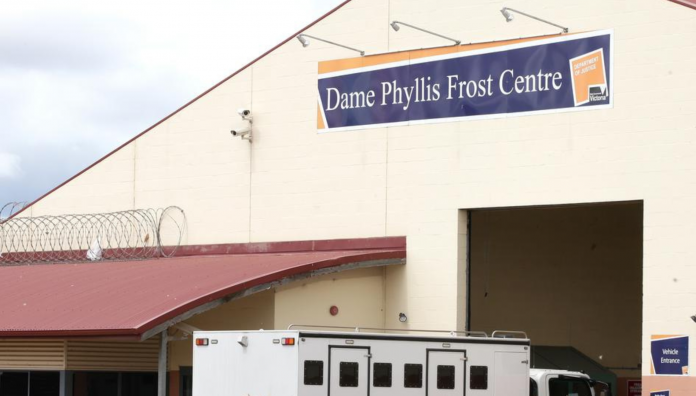
Women at the Dame Phyllis Frost Correctional Centre told the Herald Sun that the transgender male offender was moved to the Murray Protection Unit on July 5.

According to the Dame Phyllis petition, many women prisoners have been the victims of sexual assault and as a result, many “carry significant trauma associated with this experience.”

The petitioners say they have no prejudices against transgender individuals but are concerned for their safety as the inmate has a “working” penis and a history of violent sexual assault. Upon learning of the convict’s transfer, “the mental well-being of many of the women was severely compromised. They became visibly upset as they were triggered and traumatised,” reads the petition.

Those women residing in the Murray unit allege that they were initially told the inmate would be “locked down 23 hours a day”, but that ultimately administration aimed for “a full living, working and socialisation integration.”

They addressed the Minister for Corrections, the Department of Justice and Community Safety, Corrections Victoria and the Ombudsman when asking for the matter to be handled swiftly.

“We feel threatened, unsafe, distressed and traumatised with this current situation. Accordingly, we demand that (the inmate) be immediately removed from the Murray unit,” the petition says. “We consider this petition a matter of urgency and would therefore appreciate your prompt response.”

The report from the Herald Sun stated that the trans-identifying inmate pleaded guilty last year to sexually assaulting a woman on a street in Richmond, “while still a man.” Additionally, the news outlet revealed that the male transfer had also spent time in a European jail for a child sex offense.

While the name of the transferred inmate was not released, the details from the criminal’s background mirror that of Lisa Jones, a trans-identified male who had been sentenced to 3 years and 3 months in prison for sexually assaulting a woman last year.

Jones, aged 44 at the time, had stalked a woman as she was walking home on Lennox Street in Richmond before grabbing her and attempting to rape her. While pinning her down, Jones repeated: “Why won’t you lay down and have sex with me?”

The woman had been on a phone call with her mother at the time, and began screaming her location into the receiver before Jones snatched the phone away and disconnected the call.

Jones put his hands down the woman’s underwear and tried to pull down the victim’s jeans, but she was able to successfully fight him off as bystanders came rushing to her aid. Jones was ultimately detained after some bystanders chased him down as he tried to flee the scene.

“I didn’t do anything, it was her fault,” Jones, whose birth name is presently unknown, was reported to have said.

While hearing the case, Judge Pardeep Tiwana told Jones, “You physically restrained her despite her screams for help and telling you to stop, you persisted.” Tiwana added that it was a “brazen and opportunistic” attack against a complete stranger.

During the trial, it was revealed that Jones had a prior record for sexually abusing a 6-year-old girl in Germany, for which Jones served six years in a male prison there prior to being deported to Australia in 2018.

Australian media coverage of the assault referred to Jones as a woman and utilized feminine pronouns for him, with some outlets even insisting the sex attack had been “woman on woman” violence. News.com.au referred to Jones as a female, and repeatedly informed readers that he was a woman.

The lack of clear details and facts-based reporting resulted in a slew of feminists to take to social media and protest how Australian media had framed the attack.

“It’s a man, a male, aka a person with a penis. You should probably know this,” wrote Gaye Chapman of lesbian-focused lifestyle outlet After Ellen.

“Not a woman. Might call themselves one, might even have a piece of paper that says they should, in law, be treated as one, but that person is not, has never been & never will be, a woman,” said Twitter user CJ Smith, “You demean the experience of the woman who was attacked.”

While each state in Australia has different policies with respect to housing transgender inmates, according to Women’s Forum, New South Wales, Victoria, the Australian Capital Territory and Tasmania “have a ‘self-identification policy’, meaning that prisoners are meant to be placed in a facility based on how they identify, unless there are safety concerns or doubts around the authenticity of the prisoner’s gender identification.”


Reduxx is your independent source of pro-woman, pro-child safeguarding news and commentary. We’re 100% reader-funded! Support our mission by joining our Patreon, or consider making a one-time donation.